The short answer
Choose mPVC when the pipe will be handled roughly, laid in rocky trenches or used on pumped lines that see pressure surges. It is tougher and lighter for the same class. Choose uPVC where the specification calls for SANS 966-1, or where you need Class 4, which only uPVC is made in.
Both are SATAS-certified (uPVC to SANS 966-1, mPVC to SANS 966-2), both are made from 50 to 500 mm, and both are designed for a service life of 50 years.
What's different about the material
uPVC (unplasticised PVC, stamped PVC-U) is rigid, strong pipe with a smooth bore. It has been the standard water-main pipe for decades.
mPVC (modified PVC, stamped PVC-M) is PVC blended with an impact modifier during manufacture. The modifier makes the material more ductile, so it resists knocks, cracking and pressure surges better. Because it's tougher, the wall can be thinner for the same pressure class.
Side by side: wall thickness and weight
The table compares the minimum wall and the mass per pipe for the same size and class. The thinner mPVC wall makes every pipe lighter to carry and lay.
| SIZE (OD) | uPVC CLASS 9 | mPVC CLASS 9 | mPVC LIGHTER BY |
|---|---|---|---|
| 63 mm | 2.7 mm4.5 kg | 1.6 mm2.7 kg | 40% |
| 110 mm | 3.9 mm11.4 kg | 2.7 mm8.0 kg | 30% |
| 160 mm | 5.6 mm24.0 kg | 4.0 mm17.3 kg | 28% |
| 200 mm | 7.0 mm37.5 kg | 4.9 mm26.5 kg | 29% |
| 250 mm | 8.7 mm58.5 kg | 6.1 mm41.4 kg | 29% |
| 315 mm | 11.0 mm93.5 kg | 7.7 mm66.2 kg | 29% |
| 400 mm | 14.0 mm147.0 kg | 9.8 mm104.0 kg | 29% |
| 500 mm | 17.4 mm229.8 kg | 12.2 mm162.9 kg | 29% |
Minimum wall thickness and mass per pipe. Pipe lengths are effective lengths, excluding the socket.
From Class 9 up, mPVC is roughly 30% lighter than uPVC of the same size and class. The thinner wall also leaves a slightly larger bore for the same outside diameter, so a little more water gets through.
When mPVC is the better choice
- Rocky or uneven trenches, where the pipe may take knocks during backfilling.
- Pumped mains that see surges when pumps start and stop or valves close.
- Sites where pipe is carried and laid by hand: lighter pipe is quicker and safer to handle.
- Drinking-water mains, irrigation, bulk transfer, industrial process water and sewage pumping lines.
When uPVC makes sense
- The specification or tender calls for SANS 966-1 uPVC.
- Low-pressure lines where Class 4 is enough: only uPVC is made in Class 4.
- Municipal and village mains, reticulation and irrigation mains laid in good ground.
How to tell them apart on site
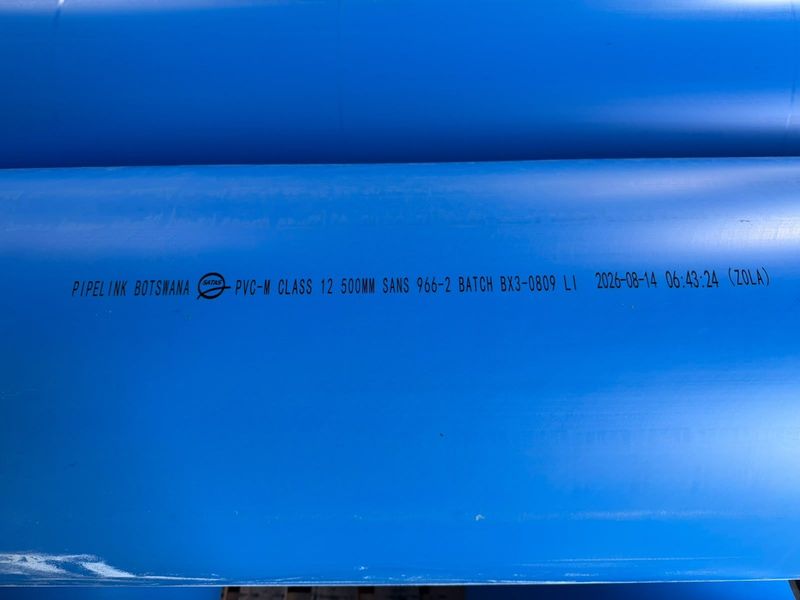
Colour is the quick check: our uPVC is light blue and our mPVC is dark blue. The batch stamp printed along every certified length confirms it: PVC-U for uPVC, PVC-M for mPVC, followed by the class, size and standard.
Lengths, joints and service life
Both come in 6 m effective lengths up to 315 mm and 5.8 m from 355 to 500 mm. Every length has a socket with a factory-fitted rubber seal: lubricate the spigot and push it home. uPVC and mPVC are both designed for a service life of 50 years.