
The short answer
Use HDPE for anything under real pressure: the line from the pump, mains and sub-mains, and long supply runs. Use LDPE for the low-pressure end of the system: drip and sprinkler laterals, gardens and small plots. Getting it the wrong way round wastes money (HDPE where LDPE would do) or risks bursts (LDPE where the pressure is too high).
What's the difference
Both are polyethylene. High-density polyethylene is stiffer and stronger, so it's made as pressure pipe: our certified HDPE range is PE100, SATAS-certified to SANS 4427-2, from Class 6 to Class 20. Low-density polyethylene is softer, more flexible and more economical, and is made for low pressure: Class 3 and Class 6.
| HDPE | LDPE | |
|---|---|---|
| Pressure classes | Class 6, 10, 12, 16, 20 (certified PE100 range) | Class 3, 6 |
| Sizes we make | 20–110 mm | 20–50 mm |
| Feel | Stiffer, stronger | Softer, very flexible |
| Certification | SATAS-certified to SANS 4427-2 (certified range) | Not product-certified |
| Typical use | Mains, sub-mains, supply and borehole lines | Drip and sprinkler laterals, gardens |
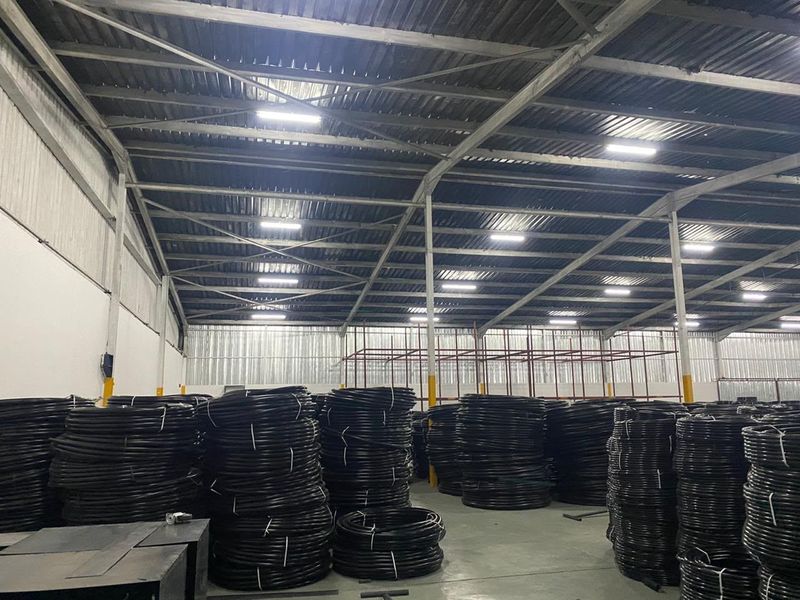
| Supplied as | Black coils | Black coils |
Where each goes in an irrigation system
- Pump to field (main line): HDPE on smaller systems, or uPVC/mPVC for larger mains.
- Sub-mains along the field: HDPE, sized for the flow.
- Drip and sprinkler laterals: LDPE, Class 3 or 6.
- Gardens, orchards and smallholdings: LDPE for low-pressure lines; HDPE for the supply to them.
How to choose the class
Check the pressure at the start of each pipe. Pressure is highest near the pump and falls along the system, so the main line needs a higher class than the laterals. As a rough guide, each class is rated for about ten times its number in metres of head at 20 °C: Class 3 for about 30 m, Class 6 for about 60 m, Class 10 for about 100 m.
Never connect low-pressure LDPE straight to a pump that can produce more than its rating. Reduce the pressure first, or use HDPE.
Laying and looking after coils
- Roll the coil along the ground to lay the pipe out, rather than pulling it off a stationary coil.
- Keep the strapping on until you're ready, and cut it carefully: coils can spring open.
- Store coils out of prolonged direct sunlight, and bury or cover lines where you can.