
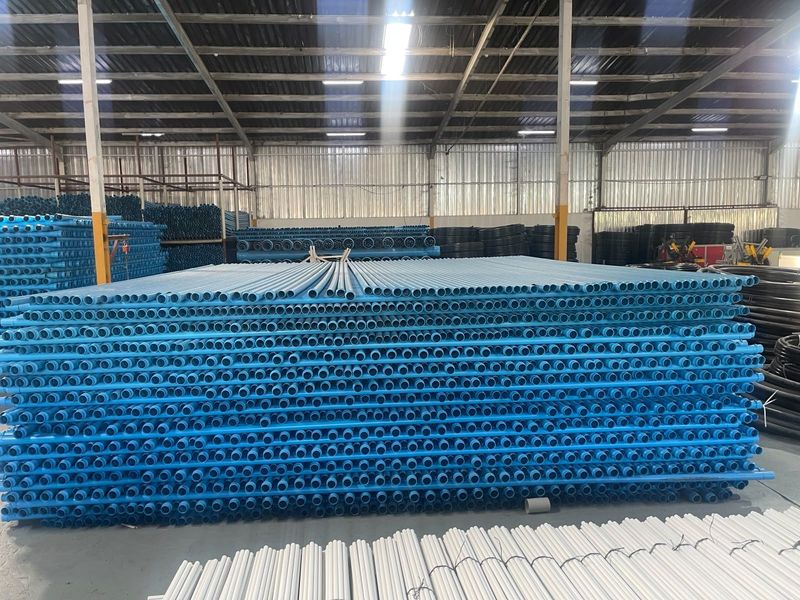
Offloading
- Lift pipe off the truck; never drop it or roll it off onto hard ground.
- Use wide fabric slings or suitable lifting equipment for large-bore pipe, not chains or wire rope against the pipe.
- Don't drag pipe over the ground or across sharp edges, and protect the spigot ends and sockets.
- Check the load on arrival and report any damage before the pipe is used.
Stacking PVC lengths
- Stack on a flat, level surface that is clear of stones, or on timber bearers spaced closely enough to support the pipe evenly.
- Keep stacks low and stable, with side supports, and put larger, heavier pipe at the bottom.
- Alternate sockets and spigots between layers so the sockets don't carry the load.
- Don't put other materials on top of stacked pipe.
Storing HDPE and LDPE coils
- Store coils flat, or upright with support, on level ground clear of stones and sharp objects.
- Keep the strapping on until the pipe is ready to lay, and cut it carefully: coils can spring open.
- Uncoil by rolling the coil along the ground rather than pulling pipe off a stationary coil.
Sun and temperature
Keep pipe out of prolonged direct sunlight. If it will be stored outdoors for more than a few weeks, cover it with an opaque, ventilated sheet, and keep rubber seals out of the sun.
PVC is less resistant to impact when it's cold, so handle it with extra care on cold winter mornings.
Jointing socketed PVC pipe
- Check the factory-fitted rubber seal is clean and seated in the socket.
- Clean the spigot and apply the lubricant recommended for rubber-ring joints; oil-based greases can damage the seal.
- Line the pipes up straight and push the spigot fully home. Don't twist or force it in at an angle.
- If you cut a pipe, square the cut and chamfer the spigot end before jointing.
In the trench
- Lay pipe on bedding free of stones, so it's supported along its full length.
- Backfill around the pipe in layers before compacting above it, as the specification sets out.
- Pressure-test the line as the project specification requires before backfilling the joints completely.
ALWAYS
This is general guidance. Follow the project specification, the relevant SANS installation code and your engineer's instructions.